The Key to Agentic Ops Is Architecture
HonestDog was built by 10 people. Today it runs on me, 23 agent roles and 41 recurring loops. People ask which agents I use, but that is the wrong question. The agents are the easy part. The key to agentic ops is architecture.
Agents are what made running a two-sided marketplace alone possible.
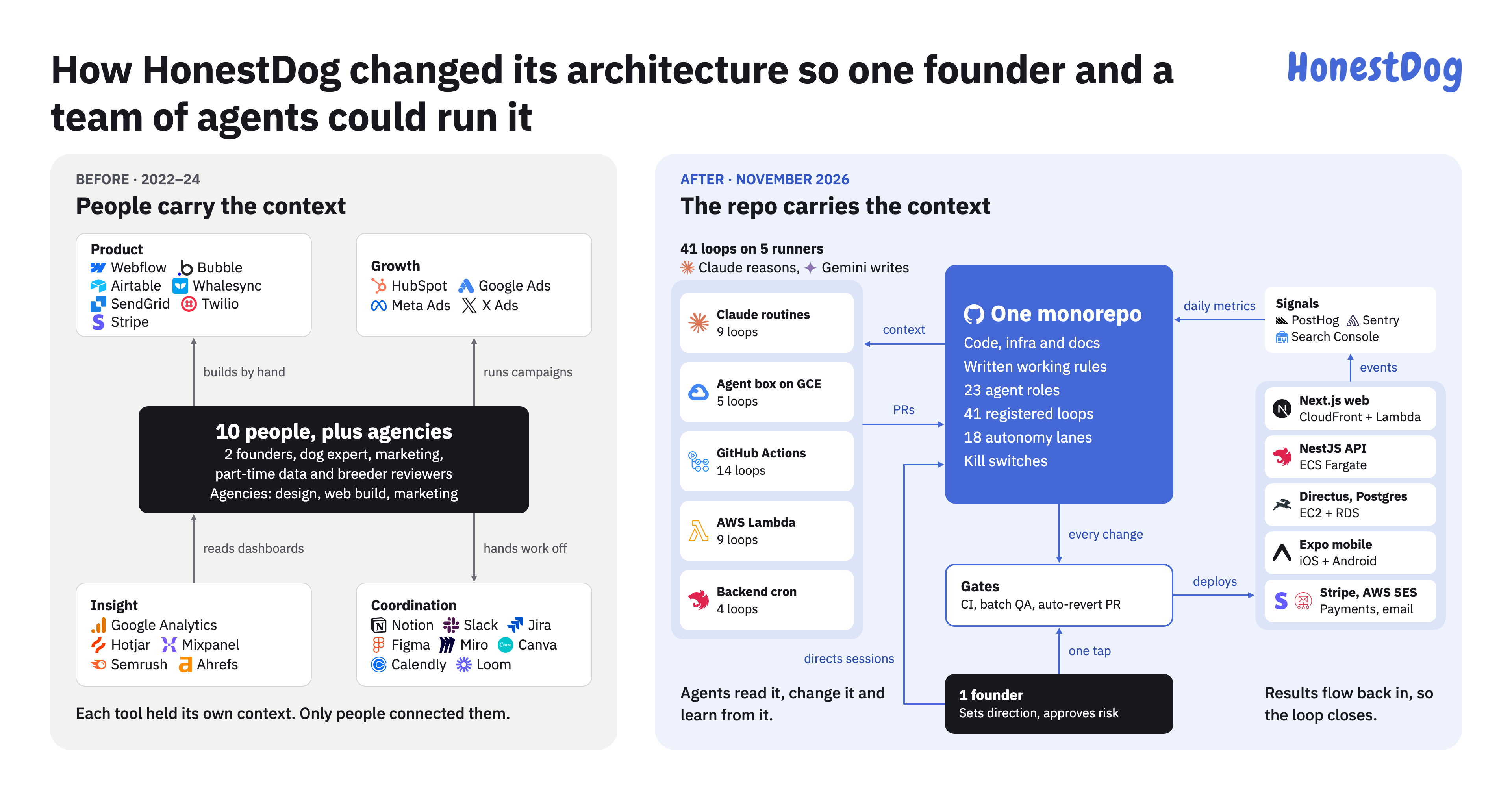
People were the wiring
At our peak, the company ran on Webflow, Bubble, Airtable, Whalesync, HubSpot, Hotjar, Mixpanel and a long list of others. Every tool was decent at its job. None of them knew what the others knew.
The connection between them was people. Someone read a dashboard and raised it at stand-up. Someone reviewed a breeder’s health documents and typed the decision into another system. The company’s real context lived in heads and handoffs.
You can’t put an agent on top of that. An agent can only use what it can read, and most of our company sat behind logins and drag-and-drop screens.
I learned this directly. In May 2025 I built a content agent, then scrapped it. The agent wasn’t the problem. The foundations were, so I went back and rebuilt those first.
The repo became the wiring
I moved everything I could into one monorepo: web, API, mobile, lambdas, infrastructure, docs and the rules agents work by. That repo now does the job people used to do. Three properties make it work.
Agents can read everything. The context an agent needs sits next to the code it changes: how we work, what broke last time, what is in flight. Every curated doc has an owner and a review date, because memory that only grows becomes misleading.
Agents can change things, within limits. Every change goes through a pull request and CI. One file defines what each of 18 autonomy lanes may do, from report-only to auto-merge. Auth, payments and the write path for buyer messages never auto-merge. No loop can widen its own lane, because that file needs my review. Production is one tap, and it is mine.
Agents can see what happened. A daily snapshot of traffic, funnel and supply is committed to the repo, so the next run starts from real numbers. If a deploy fails its checks, a revert PR opens by itself.
Read, change, learn. That loop is the architecture.
Put each job where failure does the least damage
Forty-one loops on five runners sounds like the complexity I warned about in my framework post. Each runner is there for one reason.
- AWS Lambda runs scraping and content pipelines, and keeps running if GitHub goes down.
- GitHub Actions runs repeatable checks, and always sees the latest repo.
- Claude routines do judgment work, and hold no secrets.
- The agent box does judgment work that needs logins or a browser, and is kept away from anything that can deploy.
- Backend cron checks the checkers, and fails separately from GitHub.
The rule underneath is simple. Code an agent writes stays away from anything that can deploy, and the system watching for problems can’t depend on the thing it watches.
One lesson took me a while. Any guardrail a model can reach is a cost control, not a security control. Real limits sit outside the model: branch rules, scoped tokens, permissions it can’t edit.
Watch outcomes, not activity
Agents fail quietly. One of my loops produced a single report in seven weeks while it looked alive. A sync job failed to create litters for a month with zero errors in the logs.
So every loop now has a heartbeat and an SLA, and a daily check flags any that goes missing. Health is judged by the data a system produces, not by whether it ran.
The human moves to the edge
I am not out of the loop. I still direct the hard work in live sessions with Claude Code. What changed is what reaches me.
I wrote in our decision log that my decisions were the bottleneck, so now only a short list comes to me: spending money, anything irreversible, database schema changes, anything a third party receives, production releases and credentials. Everything else gets decided, logged and carried out, and I can veto it afterwards.
That is the real shift. Before, people sat in the middle of the company. Now one person sits at its edge.
What it did, and what it didn’t
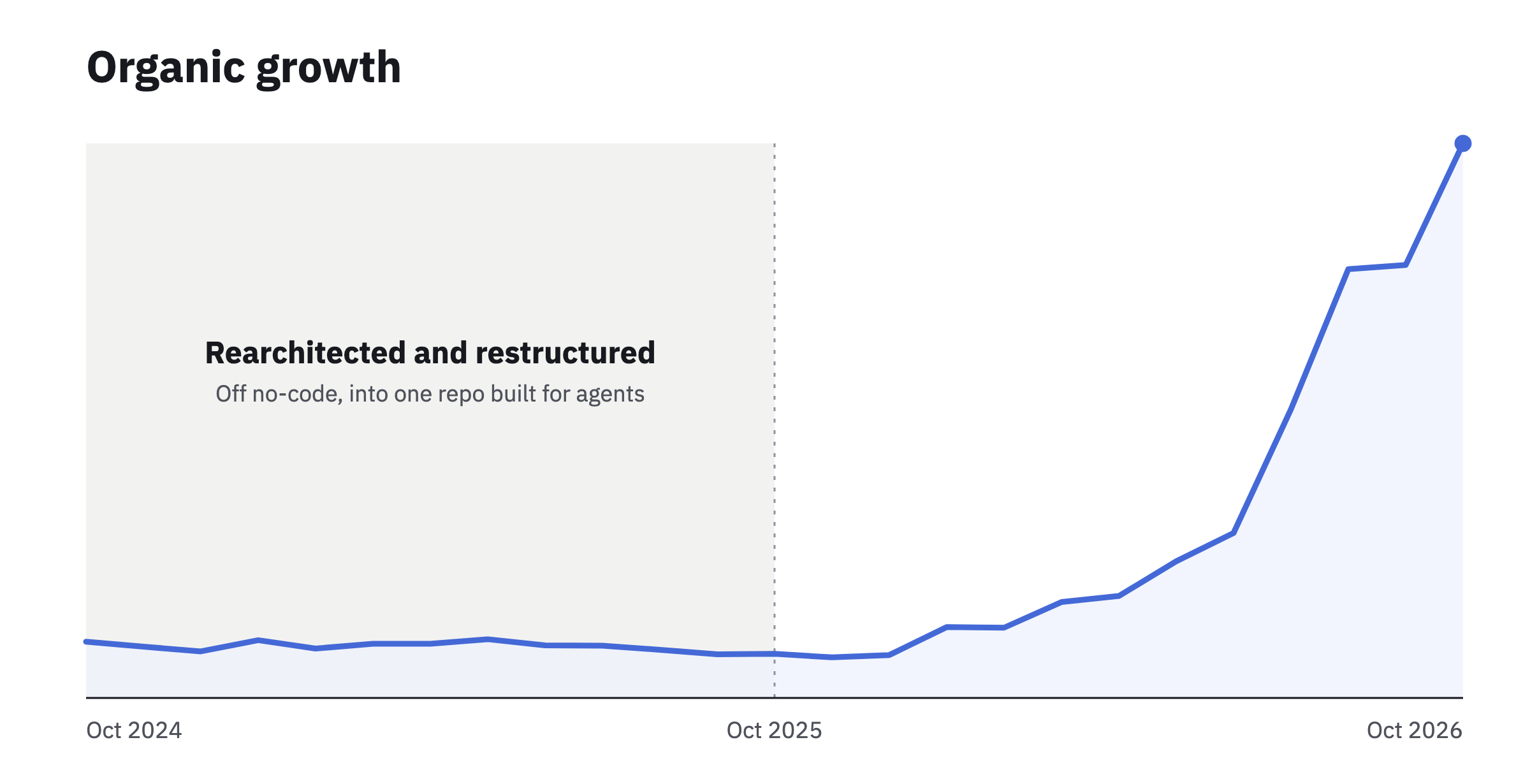
Organic growth tells the story. Traffic stayed flat through 2025 while I rebuilt, then started compounding once the foundations were in place.
It did not solve the business model, and no architecture fixes that alone. It also creates its own complexity, so I cap my time on the system at two hours a week and kill loops that don’t earn their place.
Where I’d start
- Get context out of the UIs. I said in May to default to specialised tools, and I still do. Just pick ones with an API, and leave the ones that trap your data on a screen.
- Pick one source of truth. Code, infrastructure and rules in one place that an agent can read.
- Build the gates before you grant autonomy. CI, protected paths and a way to roll back.
- Register every loop. Give each one a heartbeat and a kill rule.
- Then add agents. They will do far more with far less.
The agent you pick matters less every month. The system you give it is what you keep.
If you’re rebuilding your own company around agents, I’d love to compare notes. You can reach me at [email protected] or on LinkedIn.